
RudraX Labs
Pipeline Portal
The AI-native business development portal we built to run RudraX's own pipeline. Captures the essence of every client conversation, surfaces the next move, and replaces the Customer Relationship Management (CRM) we'd otherwise be paying per seat for.
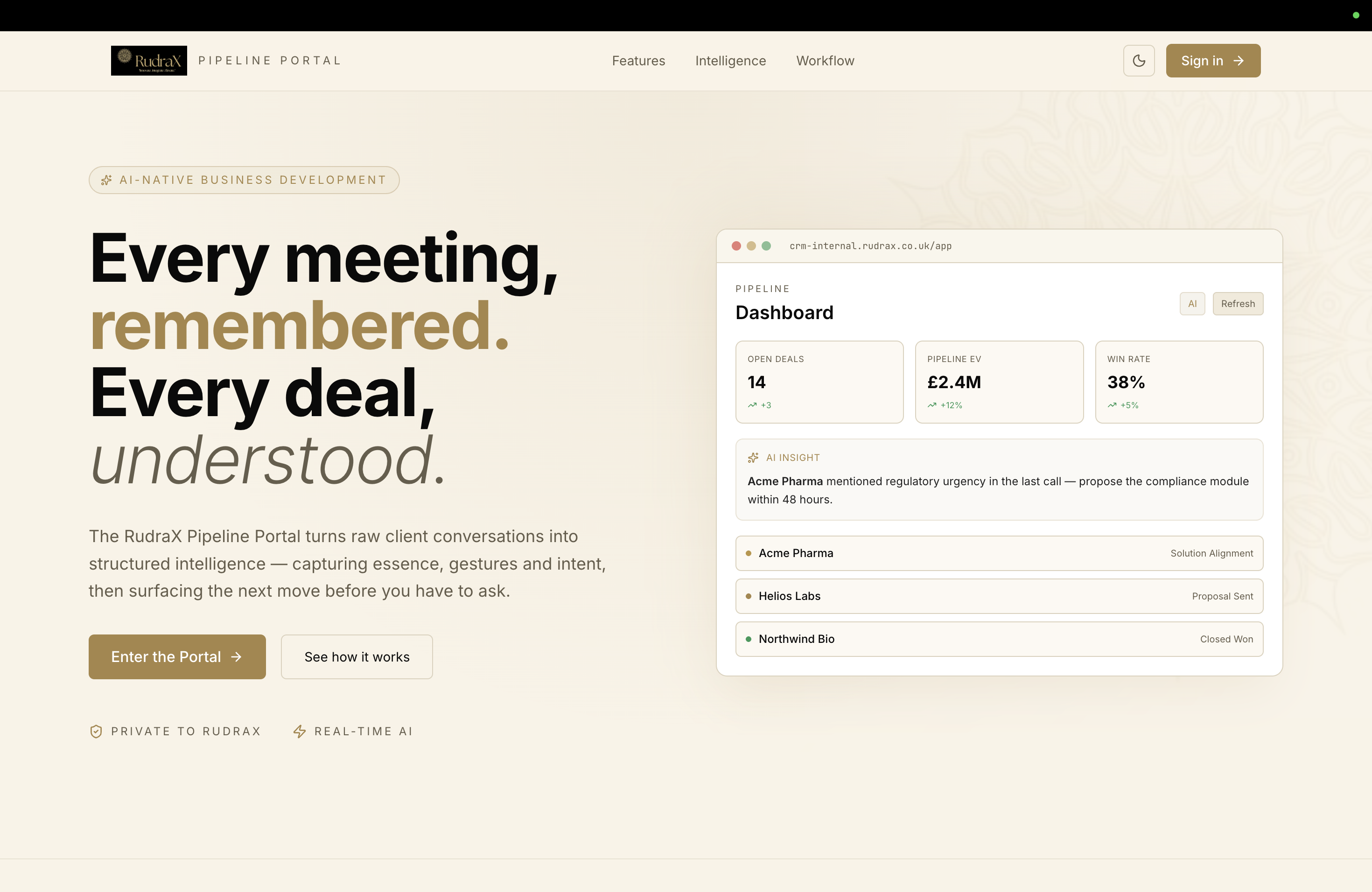
Pipeline Portal is an Artificial Intelligence (AI)-native business development system built by RudraX Technologies to run our own pipeline. It is currently the operational nerve centre of how we manage every client conversation, every meeting, every commitment, and every next step. We built it because the dominant Customer Relationship Management (CRM) platforms had become expensive, configuration-heavy, and structurally incapable of doing the thing we most needed — understanding what was meant in a call, not just what was said.
The portal is internal today. The intent is to commercialise it once it's production-hardened across more pipelines than just our own.
Why we built it
Most CRMs store what was said. They do not interpret it. They record meetings as line items, hold contacts as rows in a table, and offer pipeline stages that move only when a human remembers to move them. The disconnect between the conversation that actually happened and the system that's supposed to remember it is where most B2B deals quietly die — not because the buyer lost interest, but because the seller stopped remembering precisely what the buyer had wanted.
We watched this happen often enough to act on it. The Pipeline Portal was the response.
The thesis is simple: every client conversation contains far more than its transcript. There is tone, friction, hesitation, the moment someone leaned in. There is political context — the board pressure behind a stated requirement, the regulatory clock behind a casual question. There is gesture — what was almost said but not quite, what was deliberately understated. A well-designed AI system can extract all of that from a raw transcript or recording, structure it as actionable intelligence, and surface the next move to the human running the conversation.
We built the Pipeline Portal to do exactly that. We then put it to work on our own pipeline.
What it actually does
The portal is organised around six capabilities. Each one was scoped against the operational reality of running RudraX's business development — Sohini Mallick managing strategic relationships, Sameep Bhushan running deal mechanics, and Dr Darrell supporting on specific engagements where his domain expertise applies.
Automatic meeting logging. Drop in a transcript, paste raw notes, or upload a recording. The portal parses attendees, the discussion, the outcome reached, and the suggested stage shift in the pipeline. The work of capturing what happened in a meeting becomes the work of forwarding the transcript to the portal — which is no work at all.
Essence and gesture capture. Beyond the surface content of what was said, the portal extracts what was actually meant. Tone, friction, hesitation, enthusiasm. The hidden signal under the literal words. A client mentioning "the board has questions" reads to most CRMs as a generic comment; to the portal, it reads as a political driver that should reshape how the next conversation is framed.
Action items, owned. Every commitment made in a meeting — "we'll send the scope by Friday," "let me loop in our compliance lead," "can you confirm the June deadline" — is auto-extracted, assigned to the appropriate person, and tracked with sub-tasks and due dates. Nothing relies on memory.
Live AI insights. A refreshable second-brain reads the entire pipeline and produces a current view of which deals are alive, which are drifting, and where the next push should go. Severity-coded, deal-specific, written in the voice of someone who has actually been in the conversations.
Self-moving pipeline stages. From Cold through Closed Won, the portal proposes the next stage based on what was actually discussed, not on what the salesperson optimistically thought the meeting meant. The stage shift is the conclusion, not the input.
Backlog and forward calendar. The system holds the rolling forward calendar of follow-ups, proposals, and check-ins. Nothing falls through the cracks because the system, not the human, is the system of record for what comes next.
How we use it inside RudraX
Every client conversation we have runs through the Pipeline Portal. Every meeting, every transcript, every commitment, every stage shift. The portal is the operational record of our entire business development function — used daily by Sohini, Sameep, and Dr Darrell across two countries and a dozen concurrent engagements.
The operational pattern is worth describing because it's the actual demonstration of how AI-native business development differs from the conventional version. After every client meeting, the recording or transcript is uploaded to the portal. Within minutes, the meeting is parsed: attendees identified, discussion summarised, outcome classified, sentiment assessed, hidden signals flagged, action items extracted and assigned, and the deal's pipeline stage automatically proposed for update. A human reviews the parse, accepts or adjusts, and the deal moves forward.
The compression in time and cognitive load is significant. A two-hour meeting that previously generated 45 minutes of post-meeting administrative work now generates roughly five minutes of review. Across a week of client conversations, this compounds into multiple hours saved per person — and, more meaningfully, into a pipeline that is genuinely current rather than nominally current.
The AI insights layer is the harder-to-measure value. Twice a week, we hit refresh and the portal re-reads the entire pipeline. It tells us which deals have gone quiet, which are showing renewal signals, which need a specific gesture in the next 48 hours. The recommendations are usually right. The ones that aren't right are usually wrong in informative ways — pointing at a real signal we'd underweighted rather than at a phantom we'd hallucinated.
Where the Pipeline Portal is going
The portal is internal today and will remain internal through 2026. The reasons are deliberate. Building software for a single user (RudraX) is fundamentally easier than building software for an open commercial market — the edge cases, integrations, support obligations, and compliance burdens of a sellable product are an order of magnitude larger than the work of running a system that only your own team uses. We are not pretending otherwise.
The commercial intent is real but unhurried. The portal will graduate to a commercial offering when three conditions are met: when its core workflow has been hardened across more pipelines than just ours, when its security and compliance posture meets the bar that enterprise customers expect, and when the architecture has been generalised enough to handle different sales motions than RudraX's own. None of these is a small piece of work. We will publish a roadmap when we are ready to.
In the meantime, the portal does what it was built to do — runs the RudraX pipeline, captures every client conversation, and surfaces the next move before we have to ask. That is the asset on display in this Labs entry.
What this represents about how we work
The Pipeline Portal is one of two pieces of internal infrastructure RudraX has built rather than bought. The other is ProjectHub, our work-tracking and project delivery platform. Together they cover the two operational systems most software agencies pay considerable money to operate poorly — project delivery and business development.
We built both because the available alternatives had become expensive, configuration-heavy, and structurally misaligned with how a senior team of engineers and operators actually wants to work. Both are now used internally every day. Both are quietly demonstrating to us, and to clients who see them, what the right architecture for these workflows actually looks like.
There is a deeper point being made here. The agencies that win the next decade of mid-market technology work will be the ones that build, deploy, and run AI-native systems against their own operations before they propose them to clients. We are building the agency we'd hire if we were back where we started. The Pipeline Portal is one of the load-bearing pieces of how.
Want to build something like this?
We turn experiments into shippable products. Book a 30-minute intro call to talk through your idea.
More from the lab
FAQ