
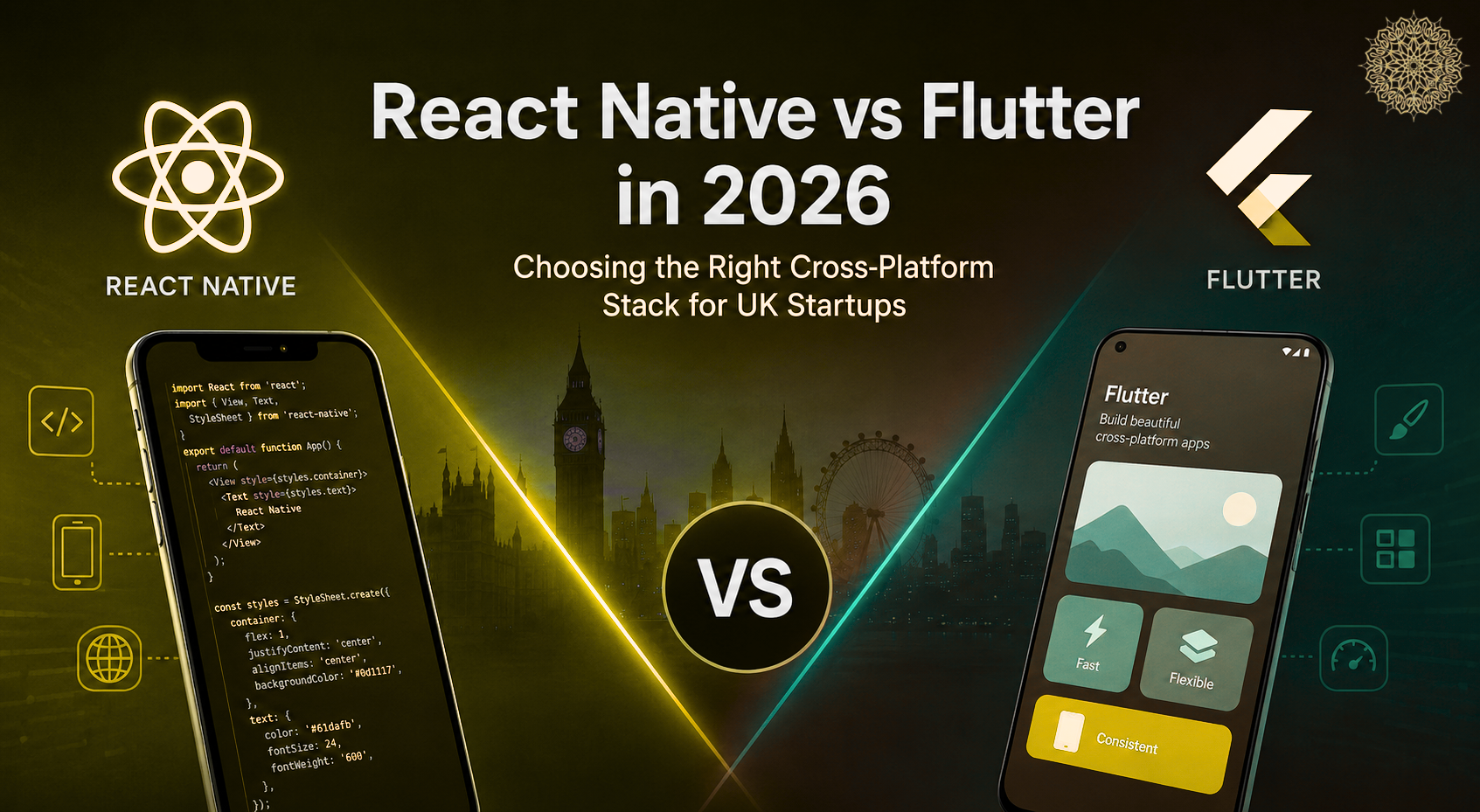
React Native vs Flutter in 2026: Choosing a Cross-Platform Stack for UK Startups
React Native and Flutter both offer powerful paths for UK startups building cross-platform applications in 2026. This guide compares their performance, scalability, development speed, ecosystem maturity, and long-term suitability to help founders choose the right technology stack for their product journey.
TL;DR
React Native vs Flutter in 2026 comes down to product needs, not popularity. React Native is often the stronger choice for startups that need flexibility, faster iteration, web integration, and access to a mature JavaScript ecosystem. Flutter stands out for teams prioritising consistent UI, custom experiences, and mobile-first products. Both can power scalable applications. The right choice depends on your roadmap, architecture, user experience goals, and future growth plans.
The technology stack a startup chooses today can define how quickly it adapts, grows and competes tomorrow.
It is a business decision that affects how quickly you authenticate an idea, how assuredly you scale, how much you allocate on engineering, and how easily your product aligns when customers start looking for deeper functionality.
In 2026, two frameworks continue to outperform the cross-platform mobile development conversation: React Native and Flutter. Both assure faster delivery, reduced development overhead, and the proficiency to launch products across iOS and Android from a shared codebase.
But the real consideration for UK startups is not:
“Which framework is better?”
The better question is:
“Which framework fits the product we are trying to build?”
A fintech platform with strict compliance needs, a SaaS product looking for rapid MVP validation, and an AI-powered consumer app will all have different priorities.
This guide compares React Native and Flutter through the perspective that matters most for founders — performance, scalability, development speed, ecosystem maturity, and long-term product growth.
The Cross-Platform Decision Has Changed
A few years ago, going cross platform often meant choosing efficiency at the cost of certain capabilities.
Teams had to choose between:
- Faster development with limited native experience
- Native performance with higher cost and longer timelines
That gap between the two has shrunk significantly. Modern frameworks can now support production-grade applications used by millions of people.
The uncertainty around cross-platform development has largely been replaced by tactical decision-making.
A strong software development agency partner will usually analyze the business model, expected scale, integrations, user experience requirements, and future roadmap before advising a stack.
React Native in 2026: Why Startups Still Choose It
React Native remains a top choice for startups seeking faster development without compromising product quality.
The true strength of React Native lies in more than just a framework. What sets it apart is the mature ecosystem behind it. JavaScript and TypeScript are already firmly established across web development, backend services, and modern product teams.
For startups building connected products where the mobile app works complementing dashboards, APIs, analytics systems, and web platforms, React Native often creates a smoother engineering workflow.
A company already working with React on the web can reuse knowledge, patterns, and even parts of the product thinking across platforms.
This is why many teams searching for an application development agency consider React Native when building:
- SaaS applications
- Marketplace platforms
- Fintech products
- Enterprise dashboards
- AI-powered mobile experiences
React Native supports startups where uncertainty is part of the journey.
The future roadmap is often shaped by customer feedback, market shifts and new opportunities.
A flexible ecosystem helps products grow without slowing momentum.
Flutter in 2026: Where It Stands Out
Flutter has emerged as a strong contender by taking a different approach to cross platform development.
Rather than depending primarily on native components, Flutter manages the entire rendering process through its own engine.
The advantage?
Greater Consistency.
Applications built with Flutter can maintain a more unified visual experience across platforms with fewer interface variations.
Consumer applications, mobility platforms, fintech interfaces, and products with highly customized experiences often benefit from Flutter’s approach.
Flutter takes a component driven approach to UI development.
Its widget system allows developers to assemble polished interfaces efficiently while maintaining consistency across platforms.
For startups ,this creates a practical advantage-faster development, cleaner design and shorter time-to-market.
Performance: Which One Wins?
The performance difference between React Native and Flutter is smaller than many founders expect.
For most modern applications, both can deliver excellent results. The real deciding factor is often not the framework itself, it is the architecture behind the product.
A poorly structured application will face limitations regardless of the technology choice.
A well-engineered product with proper backend architecture, database design, API optimisation, and cloud infrastructure can scale effectively.
Development Speed and MVP Delivery
For startups, speed matters. Not because rushing is good.
Because every month spent building without market feedback increases risk.
Both React Native and Flutter are top choices for MVP development.
React Native often wins when:
- The startup already has React expertise
- Web and mobile products are closely connected
- Third-party integrations are important
- The product needs frequent iteration
Flutter often wins when:
- UI consistency is critical
- The product is mobile-first
- The design system is highly customised
A strong MVP development agency starts with the product objective.
Ecosystem and Future Scalability
The technology choice should survive beyond launch.
A startup should think about:
What happens when we have 100 users? What happens when we have 100,000? What happens when we add AI features, analytics, payments, or enterprise integrations?
React Native benefits from the massive JavaScript ecosystem.
Flutter benefits from its controlled environment and rapid evolution.
For complex products, the framework is only one layer.
Backend architecture, cloud infrastructure, security, testing practices, and engineering discipline determine long-term success.
This is where working with a custom software development UK partner can make a major difference.
React Native vs Flutter: Final Decision Guide
Choose React Native if your startup needs:
- Faster alignment with web technologies
- A large developer ecosystem
- Flexible product evolution
- Strong integration possibilities
Choose Flutter if your startup needs:
- Highly consistent UI
- Custom visual experiences
- Strong mobile-first development
- Rapid interface creation
Neither framework is universally better.
The right choice depends on your product.
Building the Right Product Stack in 2026
Successful startups don't grow by simply selecting the latest technology.
They succeed by designing the right engineering foundation early.
Today's product extends far beyond a mobile interface. They need:
- Reliable web experiences
- Cloud-ready architecture
- AI/ML capabilities
- Secure integrations
- Strong data system
- Scalable backend systems
The winning approach is not choosing one tool-it's building a stack that supports the entire product journey.
At RudraX, we help founders turn ideas into scalable digital products through app development, web platforms, custom software engineering, MVP delivery, and AI-powered solutions.
Our approach focuses on understanding the business goal first, then designing technology around it.
Because the best technology choice is not the one that looks impressive today.
It is the one that still supports today's launch and tomorrow's growth.
Related reading
Next.js vs Plain React in 2026: A Strategic Framework for Modern Web Development
Choosing between Next.js and plain React in 2026 depends on your business goals. This guide explains when Next.js delivers better SEO, performance, and scalability for UK marketing websites, and when React is the smarter choice for internal applications. Learn how framework selection affects Core Web Vitals, long-term maintenance, and digital growth, helping you make an informed technology decision for your next web project.
3 min read

Agentic AI in Production: 3 Engineering Patterns That Repeatedly Fail and 3 That Consistently Work
Everyone is talking about AI agents. Very few are talking about what happens after deployment. The difference between a spectacular demo and a production-ready AI system isn't the language model. It's the engineering architecture around it. Drawing from industry guidance and real-world product delivery, this article explores six engineering patterns that repeatedly determine whether autonomous AI systems fail or scale.
6 min read

Production AI for UK Fintech: What GDPR Adds to Your Roadmap
Artificial intelligence is transforming UK fintech, but success depends on more than powerful algorithms. GDPR compliance now shapes every stage of an AI product's lifecycle - from data collection and model training to deployment and monitoring. This article explores how fintech businesses can build production-ready AI platforms that balance innovation, security, transparency, and regulatory compliance while earning customer trust.
6 min read