
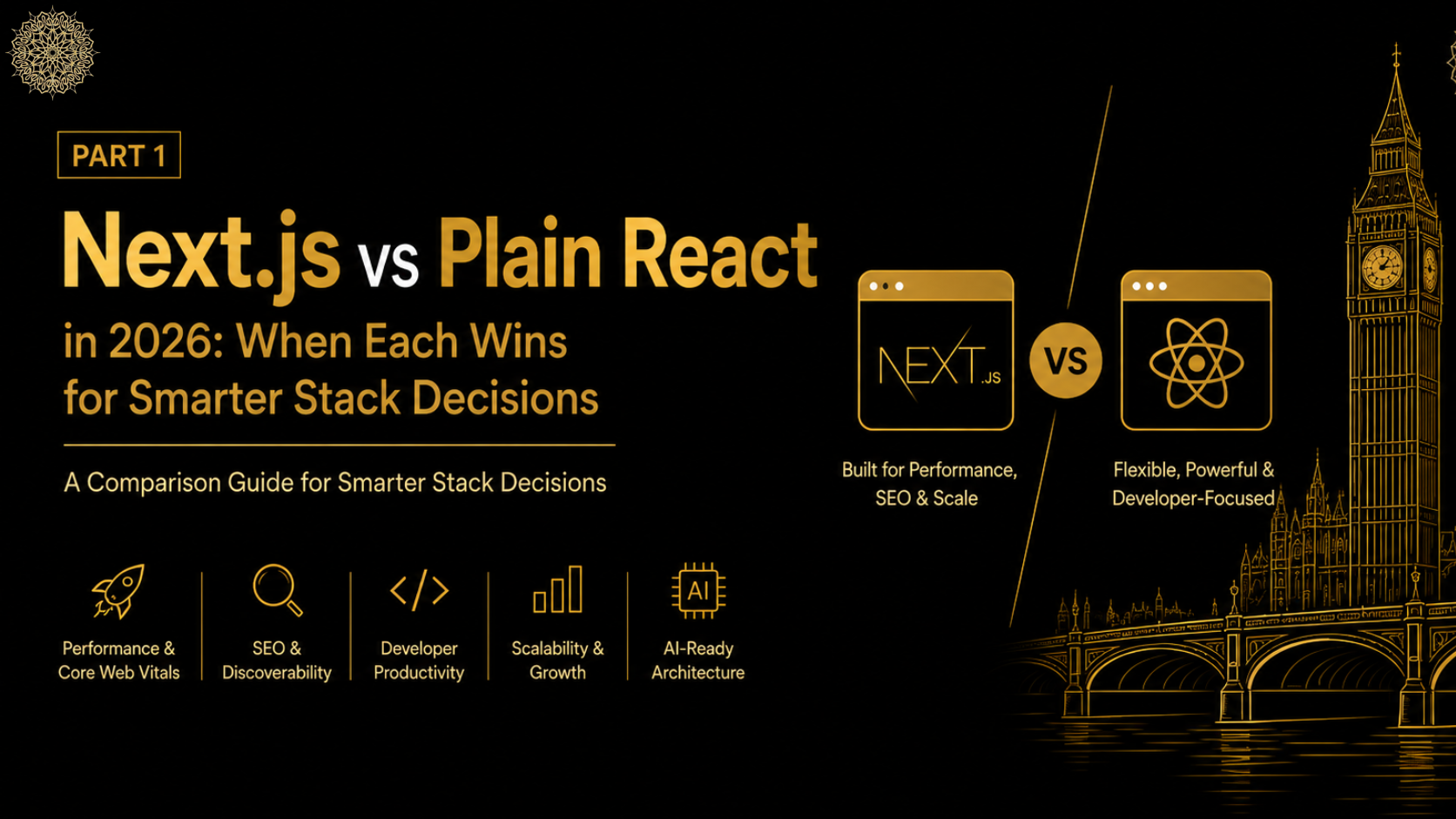
Next.js vs Plain React in 2026: A Strategic Framework for Modern Web Development
Choosing between Next.js and plain React in 2026 depends on your business goals. This guide explains when Next.js delivers better SEO, performance, and scalability for UK marketing websites, and when React is the smarter choice for internal applications. Learn how framework selection affects Core Web Vitals, long-term maintenance, and digital growth, helping you make an informed technology decision for your next web project.
TL;DR
Choosing between Next.js and React in 2026 isn't about trends, it's about business outcomes. Discover when Next.js delivers better SEO, Core Web Vitals, and scalability for UK marketing sites, and when plain React remains the smarter engineering choice.
The ongoing debate between Next.js and React remains a central topic in modern web development. However, organizations frequently view this choice through the wrong lens. Rather than evaluating which technology possesses superior features, they ought to determine which platform effectively aligns with their specific commercial objectives.
Modern web platforms in 2026 must deliver far more than basic content display. They are required to secure high search rankings on Google, offer top-tier user experiences, incorporate advanced AI functionality, generate high-quality leads, and empower agile marketing operations.
Opting for an unsuitable frontend architecture poses severe risks, including reduced site speeds, diminished SEO efficacy, increased maintenance overheads, and budget-draining future re-engineering. When selecting a Next.js development London partner or a React development agency London, businesses must prioritize their commercial objectives over developer preferences.
Why This Decision Matters in 2026
Over recent years, baseline corporate web expectations have dramatically shifted toward dynamic marketing engines that drive organic traffic and conversions. Google prioritizes sites offering seamless interactions evaluated via Core Web Vitals like LCP, CLS, and INP, which directly impact user engagement. For competitive UK sectors like SaaS, fintech, healthcare, and professional services, superior web performance is a critical business advantage that minimizes bounce rates and maximizes marketing ROI. The ideal architectural needs differ significantly depending on the application's goals: a content-driven SaaS platform heavily depends on search visibility, whereas an authenticated internal employee dashboard has no SEO requirements. Comparing Next.js and Plain React Across the Four Metrics That Matter Most
Choosing between Next.js and React is less about which technology is more popular and more about which one aligns with the technical and business requirements of your project. Although both are built on the same foundation, they approach rendering, performance, scalability, and developer experience differently. Evaluating them across four key dimensions provides a more practical way to determine which framework is the better fit.
1. Rendering and Search Discoverability
Next.js provides versatile rendering options, including server-side rendering (SSR), static site generation (SSG), incremental static regeneration (ISR), and client-side rendering (CSR), enabling per-page optimization for speed and search engine discoverability out of the box. In contrast, plain React defaults to client-side rendering, making it highly effective for interactive, authenticated user spaces, though it demands extra tooling to achieve server-rendered content or enhanced crawlability.
2. Performance and User Experience
Performance is critical for quality user experiences. Next.js provides built-in features like automatic image optimization and code splitting without extensive configuration, while React achieves similar performance through manual implementation, granting developers greater control over optimizations.
3. Development Experience and Maintainability
React provides high flexibility for customized architectures by allowing developers to choose their own libraries and tools, though this introduces extra engineering effort to maintain dependencies. Next.js solves these challenges by offering an integrated framework with built-in features like routing, optimization, and caching, which reduces infrastructure maintenance and supports predictable workflows.
4. Scalability and Long-Term Evolution
Scalability involves more than managing traffic; it encompasses adapting to new business requirements, functionality, larger development teams, and evolving technology over time. Next.js provides a robust foundation for long-term growth through built-in features like hybrid rendering and edge deployment. Similarly, React scales effectively for interactive applications and complex user interfaces using its component-based architecture. Ultimately, successful long-term scalability relies less on the specific framework and more on aligning the chosen architecture with the future direction of the product to reduce technical debt.
Why RudraX Frequently Recommends Next.js for Customer-Facing Products
RudraX client engagements demonstrate how framework selection should be based on commercial needs rather than trends. For instance, a Next.js web application for Property Energy IQ aggregated intricate UK property datasets into an intuitive search experience, illustrating that modern frameworks can deliver high-performance information while ensuring usability and scalability. Ultimately, there is no single superior option between Next.js and React; while React excels at building interactive applications, Next.js provides specialized advantages for SEO, performance, and content discoverability. Organizations should evaluate their technology stack based on specific marketing strategies, scalability objectives, user experiences, and maintenance requirements.
There is no single winner between Next.js and React. React remains excellent for building interactive applications, while Next.js introduces specialized capabilities for SEO, performance, and content discoverability. Instead of following social media hype, businesses should select a technology based on their specific marketing strategy, user experience, scalability goals, and long-term maintenance needs. The best engineering partners focus on understanding business requirements first to ensure the chosen platform drives sustainable growth and delivers measurable ROI.
Related reading

Agentic AI in Production: 3 Engineering Patterns That Repeatedly Fail and 3 That Consistently Work
Everyone is talking about AI agents. Very few are talking about what happens after deployment. The difference between a spectacular demo and a production-ready AI system isn't the language model. It's the engineering architecture around it. Drawing from industry guidance and real-world product delivery, this article explores six engineering patterns that repeatedly determine whether autonomous AI systems fail or scale.
6 min read
React Native vs Flutter in 2026: Choosing a Cross-Platform Stack for UK Startups
React Native and Flutter both offer powerful paths for UK startups building cross-platform applications in 2026. This guide compares their performance, scalability, development speed, ecosystem maturity, and long-term suitability to help founders choose the right technology stack for their product journey.
5 min read

How to choose an MVP development agency in London: A 12-point checklist
A practical 12-step framework for UK startups to choose the right MVP development partner in 2026 — covering scalability, SaaS architecture, AI readiness, technical execution, and long-term growth.
5 min read